Categories
-

0 Letter of Support to the Congressional Main Street Caucus
- August 2025
- by Administrator
- 08/05/2025
0.00 of 0 votesDate: Tuesday, August 5, 2025 To: The Honorable Members of the Congressional Main Street CaucusFrom: Ricardo Santiago Soto for Trustee Exploratory CommitteeAllan Hancock Joint Community College District Board - Area 5 Subject: Letter of Support - Workforce Development and Higher Education Initiative Dear Esteemed Members of the Congressional Main Street Caucus, I am writing to express my strong support for the Congressional Main Street Caucus's commitment to strengthening America's small businesses and local economies. As the candidate for Trustee at Allan Hancock Joint Community College District Board - Area 5 in 2026, my campaign is fundamentally aligned with your mission to promote policies that support workforce development and higher education as catalysts for economic growth. Our Shared Vision for Economic Development My 27 years of experience as a journalist and editor for The Journal for Innovation Corporation, which I founded in 1998, has given me unique insights into the transformative power of futuristic technologies. Through my work covering artificial intelligence, biotechnology, blockchain, cyber security, data science, robotics, and other emerging industries, I have witnessed firsthand how these technologies can revolutionize small business operations and create unprecedented economic opportunities. Workforce Development Through Advanced Technology Education My platform centers on bringing these advanced technologies to Allan Hancock College as diploma, certificate, and degree offerings. This initiative directly supports small businesses by: Creating a skilled workforce equipped with cutting-edge technological competencies Establishing innovation hubs that foster tech startups and entrepreneurial ventures Building research think tanks focused on practical solutions that make business operations more efficient and profitable Training robotics managers to handle modern manufacturing plants and automated systems Economic Impact and ROI Focus As someone with an MBA in Finance from Aspen University and a BSBA from Capella University, I understand that higher education must deliver measurable returns on investment. My approach ensures that workforce development programs directly translate to: Time and energy savings for small business operations Increased earning potential for workers and business owners Enhanced competitiveness through technological adoption Economic prosperity that benefits entire communities Supporting Small Business Through Education The Congressional Main Street Caucus recognizes that small businesses are the backbone of America's economy. My campaign's focus on implementing futuristic technologies in education creates a pipeline of talent that small businesses desperately need to compete in the modern marketplace. By training students in AI, cybersecurity, biotechnology, and other emerging fields, we're preparing them to either start their own innovative businesses or provide essential services to existing small enterprises. Community-Centered Approach My platform emphasizes serving the community and public good by understanding and responding to the educational and future workforce needs of our local economy. This aligns perfectly with the Main Street Caucus's commitment to policies that strengthen local communities and support grassroots economic development. Call to Action I respectfully request the Congressional Main Street Caucus's support for our workforce development initiative at Allan Hancock College. Together, we can create a model that demonstrates how community colleges can serve as engines of economic growth by bridging the gap between emerging technologies and small business needs. Our shared commitment to economic development, technology innovation, and workforce preparation positions us as natural allies in building stronger, more prosperous communities. I look forward to collaborating with the Congressional Main Street Caucus to advance policies that support both higher education and small business success. Thank you for your consideration and continued leadership in supporting America's small business community. Respectfully, Ricardo Santiago Soto, MBACandidate for TrusteeAllan Hancock Joint Community College District Board - Area 52026 Exploratory Committee Contact Information:Email: rss@ricardosantiagosoto.orgWebsite: https://www.ricardosantiagosoto.org
-
0 Highlights of 'What It Really Takes to Serve Student Basic Needs: Housing' webinar
- July 2025
- by Administrator
- 07/29/2025
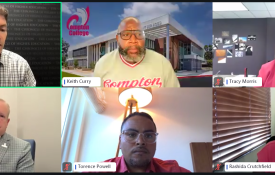
0.00 of 0 votesTuesday, July 29, 2025 11:00 AM PST In 'What It Really Takes to Serve Student Basic Needs: Housing' ModeratorIan Wilhelm, deputy managing editor, The Chronicle of Higher Education PanelistsKeith Curry, president, Compton College- says he is concerned for his students regarding financial aid. Did learn about the budget reconciliation process including with help from association of community college trustees.- is focused on impact and success as things happen with trump executive orders, because people are going to look to him about how well his students are performing and succeeding.- participated in surveys. he learned about dealing with homelessness in graduate school such as development. he reached out to dr tracy morris for help and insight from her dissertation. Tracy Morris, president, Illinois Valley Community College- says her duty is to do things right when it comes to housing by giving students a place to live revolved around their experience. says she created a food bank to help students with food needs, which increased over 200% in activity. says overcharging taught her not to do that when it comes to housing. Rashida Crutchfield, professor, School of Social Work, and Executive Director, Center for Equitable Higher EducationCalifornia State University, Long Beach- works at a center that studies issues such as housing and homelessness. says they do have data on who needs help who receive an award letter. she seeks to dismantle competing theories that affect her college related to student struggling. Torence Powell, president, Napa Valley College- second largest housing project. receives state subsidies from the state of California. works with foundations and nonprofits to help students meet their basic needs including transportation. has an endowment from two sources which has generated $200,000 in student aid. seeks to bridge the gaps so the student can focus on their education and allow loans to be used later as needed. says mental health services have doubles since being implemented, which shows a strong need for students. created a room for kids, while parent students are in class. Poll43% strongly agree housing big problem facing students on my campus, 41% somewhat agree. 9% somewhat disagree, 1% strongly disagree, 6% unsure. Jay Allen, president, Itawamba Community College- Looks to create a sense of community. lives on campus, which is a neat experience for him. Charges $1000 for bed, $100 for meal plan, affordable. It helps solve problems. Jay extended an offer for Keith to come see how their housing is done as we all learn from one another. says his legislature passed a student need for foster students who receive housing and meals, which is a great model to have more of it. his college does match students who are homeless with those who have housing. he said that students needs like food will be placed in a locker, so the student will not feel embarrassed. says his college is a different animal as it does not have any family lifestyle rooms.
-

0 A reply to The Chronicle of Higher Education 07/24/25 article
- July 2025
- by Administrator
- 07/25/2025
0.00 of 0 votesIn 'To Raise Money for His Students, This College President Started Running. And Running. And Running.' by Aisha Baiocchi dated July 24, 2025 article within The Chronicle of Higher Education. Community college president Tim Cook describes his efforts about fundraising through running and how it has gained media attention. Overview I understand how students may struggle, while attending a community college as I did as well. I tried to work a job and found it difficult to attend classes full-time. I became a nontraditional student, studying half-time, while living as a caregiver and participating in extracurricular activities. I feel for the student who faces many challenges, then and now. Students are facing financial troubles as detailed in the article, whether requiring a living wage, grants and/or loans. It is easy to praise Tim Cook, president of Clackamas Community College for his dedication and hard work in helping his students face hardships. It is impressive that Mr. Cook runs marathons in his current effort to raise funds for the college's foundation, which will be given to students facing economic difficulties so they can continue to attend class. Tim's efforts have gained media attention, which is wonderful. Tim says that he does not expect president's of other colleges to run marathons or miles a day to help raise money for students. Tim says he will help work with state legislators in Oregon to help pass legislation. Current efforts are underway to help fund students needs. The media attention has helped spark the need for his state and community college network to be on the state's radar. State and federal educational funding outreach It is my hope that the students in Oregon contact their local and state representative about their problems. Students may call, text, write, and/or fax their story to their representative to educate them. Students may visit the representatives office when available. If students are in Washington DC they may visit their federal office as well. Keep the pressure on until legislation is created and passed into law.
-

0 A reply to The Chronicle of Higher Education 07/23/25 article
- July 2025
- by Administrator
- 07/24/2025
0.00 of 0 votesIn 'Instructors Will Now See AI Throughout a Widely Used Course Software' by Sarah Huddleston gives us a modern use of artificial intelligence being used in Canvas, as well as, Instructure educational platforms. There seems to be more pros than cons in this AI debate: Pros -Teachers will keep their jobs as artificial intelligence will aid them with grading workloads, such as standardizing gradings according to a rubric created by AI. -Teachers will have posts made by students summarized, which will decrease their workload and minimize any bias or subjective reflections. -Teachers will have more time to mentor students as artificial intelligence helps minimize time and effort, thus improving student outcomes, as well as, relations. Cons -Artificial intelligence may not be perfect, which requires generative AI from the instructor at all times. My perspective The teacher should stay within academia to pinpoint student weaknesses and strengths, while customizing guidance or advice along with mentoring success initiatives. The teacher or professor within one-on-one meetings with the student can determine emotions the student is feeling, which is unclear if futuristic technologies can feel yet. The teacher or professor, while mentoring can help solve problems based on how the student is feeling.
-

0 A reply to The Chronicle of Higher Education 07/22/25 article
- July 2025
- by Administrator
- 07/23/2025
0.00 of 0 votesIn 'These Scholarly Topics Are Hotly Debated. So Why Don’t Syllabi Reflect That?' by Emma Pettit. It reads more as when the powerless feel powerful. When debate is one-sided, thus loss of power. Yet, when in power--debate turns to discussion, preferably, contentious politics--to never lose power again. I agree: We should seek discussion, have more of a backbone, but not seek marginalization. I think we should find common ground. I think higher education classrooms should teach from analysis texts that are based on facts, while incorporating memoirs and/or autobiographies from competing viewpoints. We should include theoretical frameworks or models to help guide our thoughts. We should always strive to advance civilization. Ricardo Santiago Soto, MBABuellton, California USA